




Revolutionizing Civil Engineering: Emerging Technologies in 2026
27-01-2026Civil engineering has always been driven by innovation — from ancient aqueducts to modern skyscrapers. Today, the pace of technology adoption in civil engineering is accelerating rapidly, transforming how projects are conceived, designed, executed, monitored and maintained. These technologies not only improve accuracy and efficiency but also boost safety, sustainability and cost-effectiveness.
At GNA University, recognized among the best private universities in Punjab and acclaimed as the best engineering college in Punjab, these advanced technologies are deeply embedded into academic learning. This ensures students are well-prepared to tackle real-world engineering challenges and industry demands. Below are some of the most impactful technologies shaping the future of civil engineering.
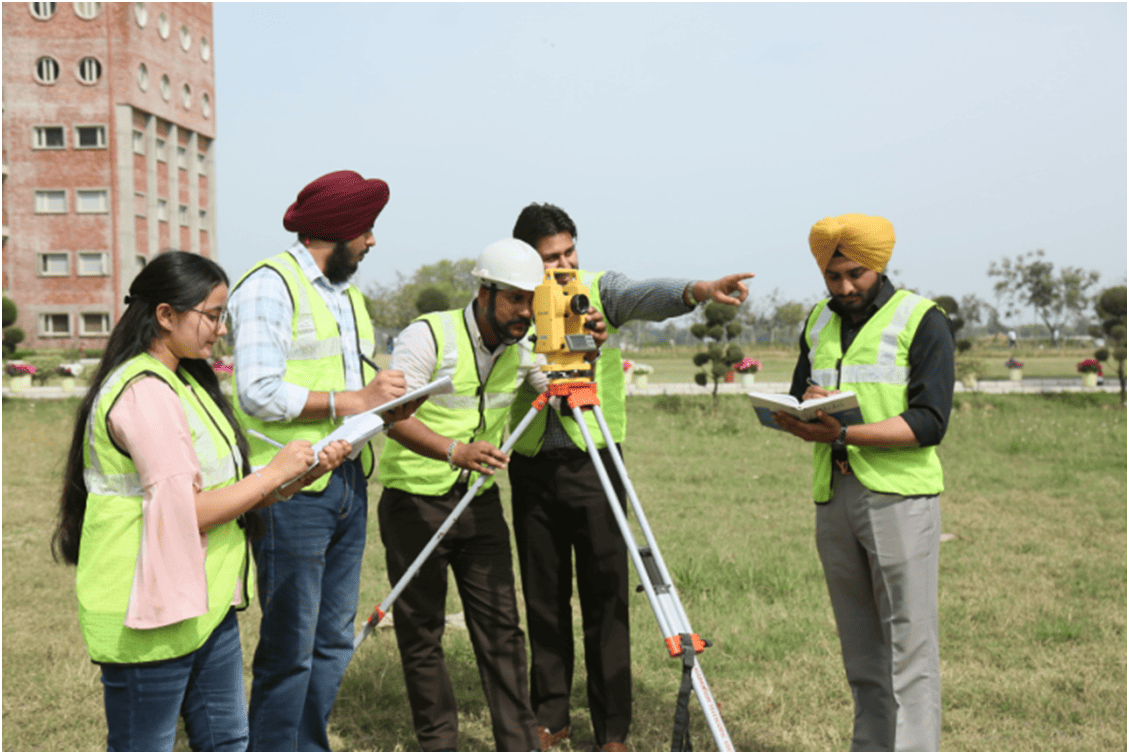
1. Drone Surveying and Aerial Mapping
Unmanned Aerial Vehicles (UAVs), commonly known as drones, are revolutionizing surveying and construction site monitoring.
Key points:
- Faster and more accurate surveys: Drones collect topographic data much quicker than traditional ground surveys — covering large sites in hours instead of days and reducing reliance on manual measurements.
- High-resolution 3D models: Equipped with LiDAR and photogrammetry sensors, drones generate precise 2D maps and 3D terrain models useful for planning, design, and monitoring.
- Safety and risk reduction: Drones inspect hazardous or hard-to-reach locations such as tall structures, deep excavations, and difficult terrain without endangering human surveyors.
- Real-time project tracking: Regular flights enable managers to monitor progress, catch deviations early, and share updates with stakeholders instantly.
- Cost and time savings: Faster data collection reduces labor, hardware, and rework costs, helping deliver projects on time and budget.
Overall, drone technology is not just a survey tool — it’s an intelligence platform that drives smarter decision-making across the construction lifecycle.
2. Building Information Modeling (BIM)
Building Information Modeling (BIM) has moved from being a design tool to becoming the backbone of modern project collaboration.
Highlights:
- Integrated digital models: BIM creates detailed 3D representations of buildings and infrastructure that incorporate geometry, time (4D), and cost (5D) data.
- Improved coordination: Architects, engineers, contractors, and owners work on a shared model, reducing errors, clashes, and rework.
- Maintenance and lifecycle benefits: BIM supports facility management long after construction is completed, acting as a “digital twin” of the asset.
- Risk reduction: Visual simulations and clash detection enable teams to foresee and resolve issues before they occur on site.
BIM fosters a collaborative environment where digital data flows seamlessly between disciplines, enhancing project quality and communication. With hands-on BIM training, GNA University strengthens its position as the best civil engineering college in Punjab, equipping students with industry-ready expertise.
3. 3D Printing in Construction
3D printing — also called additive manufacturing — is changing how structures are built.
Key advantages:
- Rapid construction: Entire walls, components, or even small buildings can be printed layer by layer, dramatically shortening construction timelines.
- Reduced material waste: Precise layer-by-layer placement minimizes waste and lowers carbon emissions.
- Design freedom: Complex geometries that were expensive or impossible with traditional methods can now be realized easily.
- Sustainability: Local materials such as recycled aggregates or clay can be used in printing, reducing transportation needs and environmental impact.
3D concrete printing is already being used for residential housing, bridges, and modular components worldwide, signaling a future where construction becomes faster, sustainable, and more customized.
With hands-on exposure to advanced construction technologies, institutions recognized as the best civil engineering college in Punjab ensure that students are equipped with future-ready skills aligned with global industry trends.
4. Internet of Things (IoT) and Smart Sensors
IoT devices and sensors are connecting civil infrastructure to real-time data streams.
Benefits:
- Monitoring and maintenance: Sensors embedded in bridges, roads, and buildings collect data on vibrations, temperature, and strain to predict maintenance needs.
- Safety improvement: Real-time alerts on structural performance help prevent failures and extend asset life.
- Optimized operations: IoT data assists in resource planning, energy management, and environmental compliance.
Smart infrastructure enhances decision-making and helps cities become more responsive and resilient.
5. Augmented Reality (AR), Virtual Reality (VR), and Digital Twins
Immersive technologies are enhancing visualization and collaboration.
Applications:
- AR/VR walkthroughs: Stakeholders can walk through virtual project simulations before construction begins, reducing design errors.
- Training and safety: Workers train in virtual environments without risk.
- Digital twins: Real-time digital replicas of infrastructure help monitor performance, plan maintenance, and improve operational efficiency.
These technologies ensure better planning and execution by bridging the gap between physical reality and digital design.
6. Artificial Intelligence (AI) and Machine Learning
AI is powering smarter decision-making across civil engineering processes.
Uses:
- Predictive analytics: AI models forecast project risks, schedule delays, and cost overruns.
- Automated design optimization: Algorithms help optimize structural designs and material use.
- Quality and safety monitoring: Computer vision and sensors detect defects and unsafe conditions in real time.
AI transforms vast construction data into actionable insights, improving efficiency and reducing waste.
Conclusion
The convergence of drones, BIM, 3D printing, IoT, AR/VR, and AI is redefining the civil engineering landscape. These technologies enhance precision, safety, sustainability, and collaboration, enabling engineers to build smarter and faster.
By incorporating these technologies into its academic framework, GNA University stands out among the best universities in Punjab and continues to be regarded as a best civil engineering college in Punjab. With a strong emphasis on practical learning, innovation, and industry exposure, the university prepares students to excel in the evolving construction and infrastructure sector.
Begin your civil engineering journey at GNA University—where innovation meets industry-ready education. Apply now through the official website.